The Carbon Footprint of Beef Is Greater Than That of Vegetables
From sandwiches to 'haemorrhage' veggie burgers, we've rounded upwards some of the latest research and innovations for a depression-carb(on) diet
Everything nosotros buy has a carbon footprint and nutrient is no exception.
Yearly, we produce five billion tonnes of carbon dioxide equivalent from ingather and livestock product.
From seed to mouth, information technology can be piece of cake to forget how much in terms of production goes into our food. So here'south a couple of things yous may not already know about the carbon footprint of your favourite dishes.
1. Sandwich fillers
Craven isn't the most carbon-intensive meat, but it may come equally a surprise to know that some of our favourite veggies have an as poor carbon tape.
Researchers from the University of Manchester recently calculated the carbon footprint of ingredients in British sandwiches. For sandwich eaters, cut out tomatoes from a classic BLT (bacon, lettuce, and tomato plant) may exist improve for the surroundings.
Natural gas and electricity are used for the heating and lighting of greenhouses for tomatoes in the United kingdom, contributing to their loftier carbon footprint. A 2009 report past the WWF found that in the UK, tomato, pepper, and cucumber product is worse for the environment than craven and turkey.
2. Tofu of united states consider everything
Demand for soy is driving deforestation, merely recollect again before you put all the blame onto tofu eaters or the vegan motility. Effectually 70% of the global soy product is fed direct to livestock.
Beef racks upward to 105kg of Co2e per 100g, while tofu produces less than 3.5kg. Trying to feed all those cows has meant that the expansion in soy has led to deforestation and the decline in other valuable ecosystems that store carbon. The Cerrado, a savanna ecoregion of Brazil, has lost one-half of its natural vegetation to soybean plantations.
One report plant that deforestation related to soy production in Brazil is responsible for 29% of the country'southward greenhouse gas emissions.
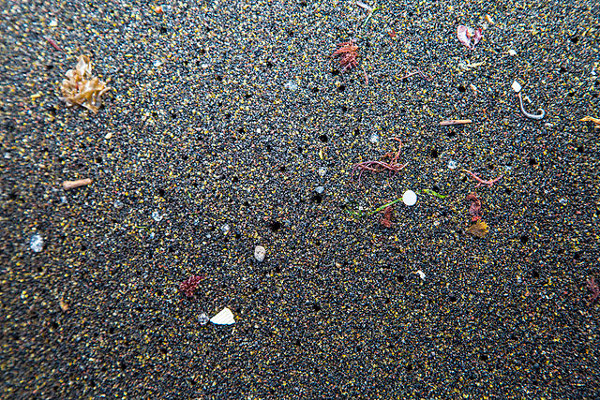
Microplastics in the Azores (Photo: Artistic Eatables)
3. Something fishy about that
Mayhap not strictly carbon footprint related, but microplastics, tiny pieces ranging from 5 millimetres down to 100 nanometers in diameter, are everywhere and a recent commodity from the Globe Economic Forum suggested that they have been institute in a range of foods from fish to honey, chicken, and beer.
Besides polluting seas and oceans, microplastics are swallowed past fish and other marine creatures and enter our system when we eat seafood. Land animals likewise eat microplastics, although, unlike with fish, nosotros tend non to eat their digestive systems.
4. Organic isn't ever amend
Organic nutrient has an image of health and sustainability but is not necessarily better for the climate than not-organic food. Ane study published in Environmental Research Messages institute exactly that in June 2017.
"Organic systems require 25 to 110% more than land use, use 15% less free energy, and accept 37% higher eutrophication potential than conventional systems per unit of nutrient," the study found. "In addition, organic and conventional systems did not significantly differ in their greenhouse gas emissions or acidification potential".
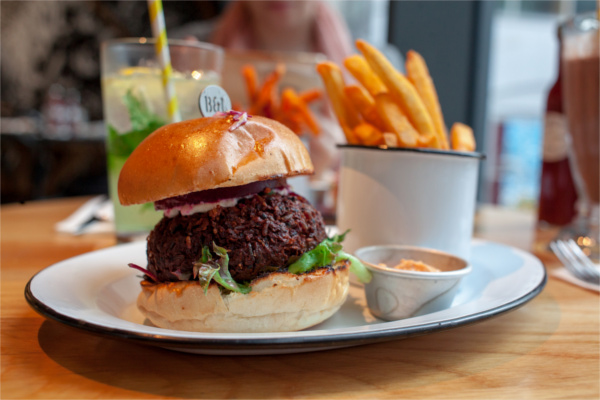
Beetroot burger (Photo: George N)
5. Bleeding burgers
There are a variety of reasons why someone would consider going vegetarian, with studies suggesting that going vegetarian "can cut your carbon footprint in one-half". While some vegetarians may miss the flavour of meat, we tin can't be certain how many miss being reminded that that'due south what they're eating.
Now, vegetarians and vegans can treat themselves to a meatless patty that literally bleeds… beetroot juice. Beyond Meat, Incommunicable Foods, and Naturli are some of the companies working on bringing meat-complimentary 'haemorrhage' burgers to the mass market place.
These burgers are either grown in labs or made from ingredients such as mushrooms, wheat, basics, coconut oil, beetroot and soy, and have a significantly smaller carbon footprint than the animal-based original.

Farmers inspecting wheat near Pullman, Washington (Photograph: Jack Dykinga)
half-dozen. Wheat for it
Most of the emissions from staples such as breadstuff come from the fertiliser used to grow wheat. A 2017 report plant that ammonium nitrate fertiliser accounts for 43% of all the greenhouse gas emissions in the production procedure of a loaf of bread.
Only can different types of bread be better or worse for the environs (too being ameliorate or worse for your torso)? Cereals used in bread, such as oats and barley, have smaller carbon footprints than typical wheat used in white loaves, as well as rye.
vii. One fashion isn't the best style
Blanket farm production doesn't work across the earth, and it's important to consider local ecosystems when looking at how best to produce food with the lowest carbon footprint.
A vegetarian typically has a smaller carbon footprint than a meat eater but the constitute-based diet isn't applied everywhere, especially for those who live in dry out or cold places that cannot support the growth of most vegetable crops.
Although approximately 1,799 gallons of h2o is needed per pound to raise a cow, the amount of h2o needed in club to successfully farm in desert-similar climates tin be huge and is currently unsustainable. Even though it may be ameliorate for the climate to exist vegetarian, for some, that just isn't sustainable.
Source: https://www.climatechangenews.com/2018/06/13/7-surprising-things-carbon-footprint-food/
0 Response to "The Carbon Footprint of Beef Is Greater Than That of Vegetables"
Post a Comment